

New article in new volume of Studien zur Musikarchäologie
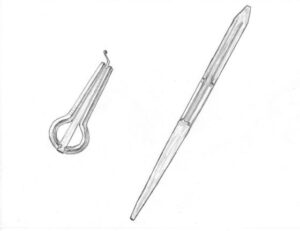
My article ‘Jew’s Harps of Bone, Wood and Metal. How to Understand Construction, Classification and Chronology’ is based on a paper from the 9th Symposium of ISGMA (International Study Group on Music Archaeology) in Berlin in 2014. It considers the relation between the two main types of jew’s harps: (1) the ‘idioglot’ or ‘lamellate’ versions, made of bamboo, wood, bone or brass, and (2) the ‘heteroglot’, bow-shaped versions, made of iron or copper alloys (including the European version).
Besides technology, the article discusses classification (including the old debate whether the instrument ‘is’ an aerophone or an idiophone) and chronology, as well the relation between them. In other words: Is there really a chronological, historical line between idioglot and heteroglot jew’s harps, as the German musicologist Curt Sachs suggested? And what about the geographical spreading from east (Asia) to west (Europe), also proposed by Sachs?
In the article, my aim has not been to resolve these blurred issues, but to approach them and ask new questions, open-mindedly. The abstract reads as follows:
‘In the classification of musical instruments, the place of the jew’s harp has for a long time been disputed. This is a complex, diverse and anomalous musical instrument, technologically and culturally. The variety of shapes and materials within its original distribution area, Eurasia, raises questions about the nature and early history of the jew’s harp. How can we understand the connection between the various forms, and their chronological significance? How do earlier theories match modern archaeological research? These questions concern both organology and archaeology.’
The article is published in R. Eichmann, J. Fang and L.-C. Koch (eds.) 2016: Studien zur Musikarchäologie X. Leidorf, Rahden/Westf.: 63–73, and can be read here (pdf).

2 Comments
Leave a Comment
Jew’s harps from the Bronze Age!
I have now travelled for some days in the Northern parts of China. In Chifeng…
On the way to China
Today I travel to China to give a lecture at the Tianjin Conservatory of Music…
New bronze lur replicas
The trombonists Jens Chr. Kloster and Gaute Vikdal has arranged, in collaboration with the bronze…
A warm welcome for Jordas skjulte toner
The book is now out and available on the market. The response so far has…
Book launch
My book, Jordas skjulte toner. Musikk og instrumenter fra steinalder til vikingtid (“The Earth’s Hidden…
Dear Professor Kolltveit,
I hope this finds you well. I am a PhD student of Chinese music archaeology at UCLA and would very much appreciate the opportunity to read your article “Jew’s Harps of Bone, Wood and Metal. How to Understand Construction, Classification and Chronology.” I am attempting to better understand the cache recently found at Shimao and am curious to read your research; unfortunately the UCLA library does not have this copy of Studien zur Musikarchäologie. May I kindly request a PDF? It would be very much appreciated.
Best wishes,
Kirie Stromberg
Dear Kirie,
I will send you a pdf of the article. The Shimao finds are really fine; great that you will work with them. Good luck!
All the best, Gjermund